
Products


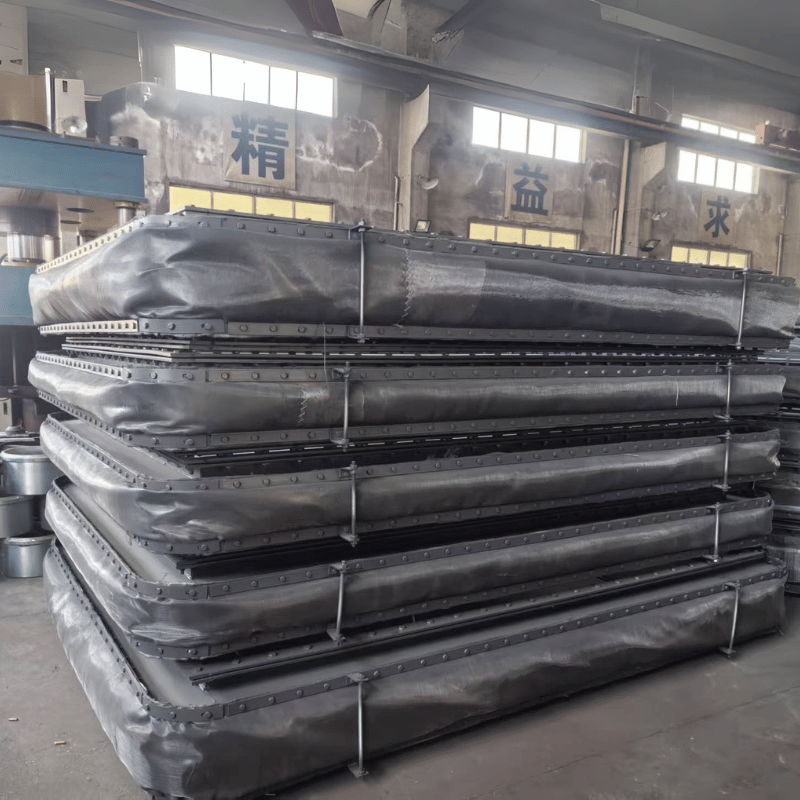
Fabric Expansion Joints
Non-Metallic Expansion Joints (Non-Metallic Compensators / Non-Metallic Fabric Expansion Joints) Product Overview Functional Features : Capable of compensating for axial, lateral, and angular displacements. Features include zero thrust, simplified support design, corrosion resistance,...
Features
Product Overview
| Parameter Table | Examples of common values |
| Service Temperature | 400°C-1000°C |
| Operating Pressure | ± 50 kPa (Low Pressure) |
| Media/Gas Type | Flue Gas, Hot Air, Corrosive Gas |
| Fabric Layers | PTFE, Silicon, Ceramic Fiber |
| Face-to-Face Length | 200mm - 500mm (Customizable) |
| Frame Material | Carbon Steel, Q235, SS304 |
Product Features
1. Exceptional Displacement Compensation Capability (Multi-plane Movement)
• Characteristics: Compared to metal bellows, non-metallic fabric compensators can simultaneously absorb substantial axial, lateral, and angular displacements within extremely short installation lengths. Even with significant pipeline misalignment, non-metallic compensators adapt effortlessly.
2. Exceptionally High Temperature and Corrosion Resistance (Temperature & Chemical Resistance)
• Characteristics: For the 400°C - 1000°C environments mentioned, this is achieved through multi-layer composite materials (e.g., PTFE, Ceramic Fiber). It withstands corrosion from strong acid and alkali fumes without developing stress corrosion cracking like metals.
3. Superior Vibration & Noise Reduction
• Characteristics: Fabric materials exhibit extremely high damping properties. Effectively isolates vibration transmission from fans and blowers, reducing system noise.
4. Minimal Spring Rate
• Characteristics: Non-metallic materials are highly flexible, generating virtually zero reaction force on connected equipment (e.g., fan outlets, expensive ductwork frames) during displacement. Protects downstream precision equipment and simplifies mounting bracket design.
5. Lightweight & Easy Installation
• Features: Compact structure requires no heavy lifting equipment; the belt can be replaced on-site. Reduces construction costs and minimizes downtime for maintenance.
Structural Components
1. Fabric Belt / Membrane
This is the most critical flexible component, responsible for absorbing displacement and sealing the medium.
• Material: For the 400°C - 1000°C environment you mentioned, it is typically composed of a multi-layer composite, including PTFE (corrosion-resistant layer), fiberglass (structural layer), and silicone cloth (sealing layer).
2. Insulation Layer / Pillow
For ultra-high temperatures up to 1000°C, the membrane cannot directly withstand such heat and relies on an insulation layer.
• Material: Ceramic fiber blanket or rock wool.
• Function: Reduces the membrane's hot-side temperature to ensure it operates within design parameters.
3. Metal Frames / Flanges
Used to connect the expansion joint to pipes or ducts.
• Material: Carbon steel (Q235/Q355) or stainless steel (SS304/SS316).
• Form: Common types include angle iron frames or flat flanges.
4. Baffle / Internal Sleeve
Installed inside the expansion joint to protect the cladding from direct media impact.
• Function: Reduces wear, prevents dust accumulation in corrugations, and lowers airflow noise.
5. Backup Bars / Retaining Bars
Metal bars bolted to secure the cladding to the metal frame.
• Requirements: Must possess sufficient rigidity to ensure even pressure distribution and prevent leakage at cladding joints.
6. Fasteners & Supports
Includes high-strength bolts, nuts, and potential external support structures.
Application Scenarios
1. Power Generation & Energy
This is the highest-demand sector in Southeast Asia, particularly for coal-fired and gas-fired power plants.
• Specific Applications: FGD desulfurization systems, SCR denitrification systems, boiler flue ducts, gas turbine exhaust.
• Required Properties: High-temperature resistance (400°C+), acid/alkali corrosion resistance, thermal expansion absorption.
2. Cement & Lime Industry
Targets large-scale cement production lines in Indonesia and Vietnam.
• Specific Applications: Kiln Hood/Inlet, Preheaters, Dust Collectors.
• Required Properties: Withstands ultra-high temperatures (1000°C+), abrasion resistance (dust erosion resistance), accommodates large displacement.
3. Steel & Metallurgical
• Specific Applications: Hot Blast Stove, Sintering Plant flue gas, heating furnace exhaust.
• Required Properties: Exceptional thermal stability, absorbs high-frequency vibrations.
4. Waste-to-Energy & Biomass
• Specific Scenarios: Secondary Combustion Chamber outlet, heat exchanger connections.
• Performance Requirements: Withstand highly complex chemical corrosion environments (hydrochloric acid, sulfur oxides).
5. Ventilation and Fan Systems
• Specific Applications: Inlet/outlet of induced draft fans (ID Fans) and forced draft fans (FD Fans).
• Performance Requirements: Vibration isolation, noise reduction, low rebound force to protect fan housings.
No Information
You Might Also Like
Send Inquiry
